Royal Caribbean Cruises Ltd ordered a third Quantum-class ship from Meyer Werft for their Royal Caribbean International brand.
The 167,800-ton vessel is slated for delivery in mid-2016.
Royal Caribbean said the pricing and terms are similar to those of the first two vessels of the series, Quantum of the Seas and Anthem of the Seas, which will be delivered in 2014 and 2015 respectively. No name has yet been chosen for the third, and finalization of the order is subject to financing conditions.
The complete story appeared in the May 30, 2013, edition of Cruise News Daily.
Thursday, May 30, 2013
Wednesday, May 29, 2013
Royal Caribbean Cancels Five More Sailings
Royal Caribbean International said late this afternoon that repairs to Grandeur of the Seas will necessitate the cancellation of a total of six cruises.
The line had previously canceled the May 31 sailing. In addition to that, they have now canceled the June 7, June 14, June 21, June 28 and July 5, 2013 sailings from Baltimore.
Passengers on the June and July sailings will receive a full refund along with a future cruise credit of 25% of the fare they paid on the canceled cruise. The future cruise credit will be good on any Royal Caribbean cruise within a year.
The complete story appeared in the May 29, 2013 edition of Cruise News Daily.
The line had previously canceled the May 31 sailing. In addition to that, they have now canceled the June 7, June 14, June 21, June 28 and July 5, 2013 sailings from Baltimore.
Passengers on the June and July sailings will receive a full refund along with a future cruise credit of 25% of the fare they paid on the canceled cruise. The future cruise credit will be good on any Royal Caribbean cruise within a year.
The complete story appeared in the May 29, 2013 edition of Cruise News Daily.


Monday, May 27, 2013
Fire aboard Grandeur of the Seas
Last updated May 27, 2013 at 9:15pm
A fire was reported aboard Royal Caribbean International's Grandeur of the Seas this morning (Monday, May 27, 2013) at 2:50am while the ship was en route to Coco Cay and 38 nautical miles from Freeport. The fire was reported in the aft mooring deck area of Deck 3 of the ship.
The US Coast Guard was notified, and Carnival Sensation, which was in the area at the time, was standing by to assist should it have become necessary.
Passengers were called to their muster stations while the ship's firefighters worked to extinguish the blaze. All 2,224 passengers and 796 crew members were accounted for. No major injuries were reported, however the ship's medical center reported treating four passengers, two after fainting, one for high blood pressure and one for a sprained ankle.
Calling passengers to their muster stations is a precautionary measure that ensures passengers are in a safe area, and everyone can be accounted for. While it doesn't mean that the ship's command is necessarily anticipating evacuating the ship, it does have everyone in position and ready should it become necessary.
The fire was extinguished at 4:58am, and once it was deemed safe, passengers were released from their muster stations. Most public areas and staterooms are accessible to passengers, however passengers are restricted from areas immediately adjacent to the fire scene at the aft of the ship.
Grandeur of the Seas sailed to Freeport under its own power for further evaluation, arriving there at 10:15am. Royal Caribbean says the ship's critical system - power, propulsion and communications - all continued throughout the incident without interruption.
Photos of the damage to the ship are below.
Royal Caribbean dispatched a support team to Freeport to assist passengers with any special needs they have. Royal Caribbean International's president and CEO, Adam Goldstein, and other executives accompanied the team and met with passengers and crew.
Most passengers chose to go ashore Monday afternoon, while some did staying aboard the ship. Passengers in staterooms affected by the fire are being accommodated in hotels in Freeport.
Late this afternoon Royal Caribbean decided to cancel the balance of the current cruise and have the ship repaired at the Grand Bahama Shipyard at Freeport.
Passengers are staying aboard Grandeur tonight (except for those in damaged staterooms who moved to hotels this afternoon), and everyone will be flown back to Baltimore on Tuesday.
Passengers will be given a full refund of their cruise fare along with a future cruise credit in the amount of the cruise fare they paid for the May 24 cruise. It is good on any Royal Caribbean cruise within a year.
This evening, Royal Caribbean announced they will also cancel Grandeur's next sailing, May 31. Passengers will receive a full refund of their cruise fare paid. If air fare was purchased from Royal Caribbean, they will also receive a full refund of that. If they purchased air fare independently, Royal Caribbean will pay the change fee for it. All passengers will also receive a future cruise credit in the amount of 50% of the fare they paid for the May 31 cruise.
A special phone line has been established for family members of passengers on the May 24 cruise and for passengers booked on the May 31 cruise needing assistance. The number is 1-888-824-0012 in the US and +1-408-916-9000 internationally.
Assessment of the repairs necessary will continue, and cancellation of additional sailings could come in the next few days.
Grandeur of the Seas was on a seven-night cruise to the Bahamas that left Baltimore on May 24. The ship had called at Port Canaveral Sunday and was planning to call at Coco Cay today (Monday).
This blog entry was updated throughout the day on May 27 as information was released. Further details appeared in the full Cruise News Daily article on May 28, 2013.
Photos courtesy of Royal Caribbean
A fire was reported aboard Royal Caribbean International's Grandeur of the Seas this morning (Monday, May 27, 2013) at 2:50am while the ship was en route to Coco Cay and 38 nautical miles from Freeport. The fire was reported in the aft mooring deck area of Deck 3 of the ship.
The US Coast Guard was notified, and Carnival Sensation, which was in the area at the time, was standing by to assist should it have become necessary.
Passengers were called to their muster stations while the ship's firefighters worked to extinguish the blaze. All 2,224 passengers and 796 crew members were accounted for. No major injuries were reported, however the ship's medical center reported treating four passengers, two after fainting, one for high blood pressure and one for a sprained ankle.
Calling passengers to their muster stations is a precautionary measure that ensures passengers are in a safe area, and everyone can be accounted for. While it doesn't mean that the ship's command is necessarily anticipating evacuating the ship, it does have everyone in position and ready should it become necessary.
The fire was extinguished at 4:58am, and once it was deemed safe, passengers were released from their muster stations. Most public areas and staterooms are accessible to passengers, however passengers are restricted from areas immediately adjacent to the fire scene at the aft of the ship.
Grandeur of the Seas sailed to Freeport under its own power for further evaluation, arriving there at 10:15am. Royal Caribbean says the ship's critical system - power, propulsion and communications - all continued throughout the incident without interruption.
Photos of the damage to the ship are below.
Royal Caribbean dispatched a support team to Freeport to assist passengers with any special needs they have. Royal Caribbean International's president and CEO, Adam Goldstein, and other executives accompanied the team and met with passengers and crew.
Most passengers chose to go ashore Monday afternoon, while some did staying aboard the ship. Passengers in staterooms affected by the fire are being accommodated in hotels in Freeport.
Late this afternoon Royal Caribbean decided to cancel the balance of the current cruise and have the ship repaired at the Grand Bahama Shipyard at Freeport.
Passengers are staying aboard Grandeur tonight (except for those in damaged staterooms who moved to hotels this afternoon), and everyone will be flown back to Baltimore on Tuesday.
Passengers will be given a full refund of their cruise fare along with a future cruise credit in the amount of the cruise fare they paid for the May 24 cruise. It is good on any Royal Caribbean cruise within a year.
This evening, Royal Caribbean announced they will also cancel Grandeur's next sailing, May 31. Passengers will receive a full refund of their cruise fare paid. If air fare was purchased from Royal Caribbean, they will also receive a full refund of that. If they purchased air fare independently, Royal Caribbean will pay the change fee for it. All passengers will also receive a future cruise credit in the amount of 50% of the fare they paid for the May 31 cruise.
A special phone line has been established for family members of passengers on the May 24 cruise and for passengers booked on the May 31 cruise needing assistance. The number is 1-888-824-0012 in the US and +1-408-916-9000 internationally.
Assessment of the repairs necessary will continue, and cancellation of additional sailings could come in the next few days.
Grandeur of the Seas was on a seven-night cruise to the Bahamas that left Baltimore on May 24. The ship had called at Port Canaveral Sunday and was planning to call at Coco Cay today (Monday).
This blog entry was updated throughout the day on May 27 as information was released. Further details appeared in the full Cruise News Daily article on May 28, 2013.
 | ||
| Grandeur of the Seas in Freeport on May 27 showing damage to the ship after a fire on the mooring deck. |
 |
| Adam Goldstein, pres & CEO, and Anders Aasen, AVP Technical Services inspect the damage on deck six. |
 | ||
| Most areas of the ship were unaffected. Here RCI president Adam Goldstein is shown talking with passengers in the Windjammer Cafe this noon. |
Wednesday, May 22, 2013
Costa Concordia Like You Haven't Seen It
This video was shot by a company called Team BlackSheep. They sell high-end drones for hobbyists (but much, much lower end than military versions). These are small four-propeller remote-controlled helicopters with cameras called Quadrocopters, costing about $1,600.
To promote their business they shoot videos with spectacular views of the world’s great cities or famous landmarks from the unusual close-up perspective of the drones.
Their latest sends a drone over and around (but not into) the wreck of Costa Concordia. It also meanders around some of the equipment readying the wreck for salvage. The video is definitely worth a look because it yields some spectacular sunset views of the ship and Giglio Island.
If you have a drone, and are planning to go to Italy, don’t plan to duplicate the flight. It apparently got Team BlackSheep in trouble with the Italian police, because Costa Concordia is off limits to everyone except the salvage crew.
To promote their business they shoot videos with spectacular views of the world’s great cities or famous landmarks from the unusual close-up perspective of the drones.
Their latest sends a drone over and around (but not into) the wreck of Costa Concordia. It also meanders around some of the equipment readying the wreck for salvage. The video is definitely worth a look because it yields some spectacular sunset views of the ship and Giglio Island.
If you have a drone, and are planning to go to Italy, don’t plan to duplicate the flight. It apparently got Team BlackSheep in trouble with the Italian police, because Costa Concordia is off limits to everyone except the salvage crew.
Monday, May 20, 2013
Medevac from Carnival Splendor
The US Coast Guard medevaced a 50-year-old man from Carnival Splendor Saturday evening (May 18, 2013) when the ship was about 150 miles east of Cape Lookout, NC. The Coast Guard launched an MH-60 Jayhawk helicopter and an HC-130 Hercules aircraft from the Coast Guard station at Elizabeth City, NC. The helicopter can be seen in the photo below hovering next to Carnival Splendor.
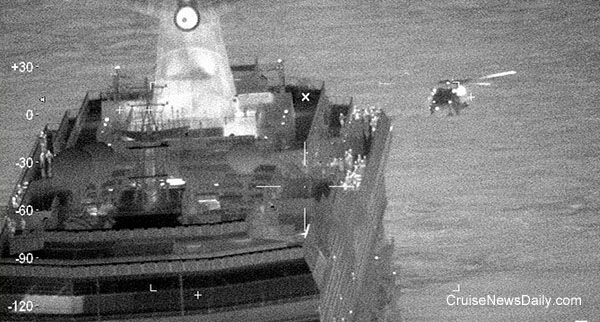
The ship contacted the Coast Guard Saturday evening about 8pm reporting the man had a heart attack and requested assistance in getting him to a shoreside medical facility. The Coast Guard airlifted him from the ship and took him to a Norfolk hospital. He was reported to be in stable condition.
In the infrared video below you can see the Coast Guard rescue swimmer first being lowered to the deck. The first to be hoisted to the helicopter is a nurse from the cruise ship, followed by the patient and finally the rescue swimmer returns to the helicopter.
But there's one more part to the story. It was the rescue swimmer's first mission. The Coast Guard tells us his interesting story below the video.
On a stormy spring night at Coast Guard Air Station Elizabeth City, N.C., Coast Guardsmen stood watch, ready to respond at a moment’s notice. Following a busy afternoon of searching for two missing boaters, the evening was accompanied by nothing more than the occasional crackle of a VHF-FM radio, followed by prolonged silence.
Around 8 p.m. a call came in from a medical representative from the 952-foot cruise ship Carnival Splendor. A 50-year-old man suffered a heart attack and needed to get to a hospital.
The ship was 150 miles east of Cape Lookout, N.C., in the Atlantic Ocean and the Coast Guard was the most qualified to respond. As the search and rescue alarm sounded, it was operations normal for most, another chance to save a life.
However, for one junior petty officer, this medevac case was far from normal. He left out on his first rescue case since earning his spot as the 830th Coast Guard rescue swimmer and the journey he's taken to get to this moment has been a challenging one.
Fresh out of rescue swimmer school and EMT school, Petty Officer 3rd Class Steve Scheren spent the last year training for this day and accomplished what he set out to do three years ago.
Scheren completed his 12-week airman program at Air Station Elizabeth City, where rescue swimmers challenged him mentally and physically on a daily basis to ensure he was prepared for his upcoming advanced training program.
After completing the prerequisite airman program, he began his 16-week rescue swimmer school in Elizabeth City, where he beat attrition rates averaging 50 percent and peaking at 80 percent.
Scheren spent countless hours in the pool building his strength and endurance, and in the classroom he built his foundational knowledge on medical response.
Tonight, as Scheren grabs his gear and runs toward the MH-60 Jayhawk helicopter, he’s confident he can save this 50-year-old man’s life.
Crews aboard an MH-60 Jayhawk helicopter and an HC-130 Hercules aircraft took off from the air station and headed out over the Atlantic Ocean as the sun began to fade over the horizon.
At approximately 9:30 p.m., the Hercules crew hailed the personnel of the cruise ship and began to discuss their plans for medevacing the man.
Meanwhile, the Jayhawk was en route, traveling nearly 180 mph. Scheren was aboard and had plenty to keep him busy while flying across open ocean toward the ship.
“I wasn’t trying to think of it as a first rescue,” said Scheren. “I was just thinking about my training and the procedures and protocols that I’d been taught.”
Running scenarios through his head, Scheren was making sure he had the equipment he needed and was thinking about what he had to do.
“Most Elizabeth City swimmers’ first rescue seems to be a cruise ship medevac,” said Scheren. “The procedure for getting people off [a ship] is pretty standard, unless you have unfavorable weather conditions. You’re going to follow a pretty simple plan.”
Having spoken to other swimmers in school and in his shop, Scheren heard stories of others’ first rescues, which helped the situation feel more natural and instilled confidence in him.
As the helicopter came to a hover off the port side of the cruise ship, Scheren realized how calm the conditions felt, speaking to the seasoned pilot’s ability to stabilize the aircraft in 20 mph winds and five to 10 foot seas.
As the flight mechanic connected the helicopter’s hook to Scheren’s harness and said “load check complete,” the only thing on his mind was making contact with the medical personnel and getting to the patient.
“When I got on scene, it was hard to differentiate who was who amongst probably 20 people,” said Scheren. “The first thing was to identify who I needed to be talking to-their doctor and nurse.”
Once Scheren made contact with the doctor, they led him inside the ship and into a small room where he first saw the survivor, who was conscious and in stable condition.
“I wanted him to feel comfortable with me,” Scheren said. “I wanted to put him at ease and not cause him any more stress than necessary.”
First, the ship’s nurse was hoisted into the helicopter.
The next order of business was to get the patient from the gurney to the litter. The survivor was rolled onto the deck of the ship, an area that provided a level and open platform for the gurney to be positioned beside the litter and for people to work. Scheren and some of the ship’s crew grabbed the sheet beneath the survivor and transferred the man onto the litter, where the spotlight of the helicopter greeted them.
Scheren signaled to the helicopter that he was ready for the survivor pickup. As the hook was lowered from the helicopter, he battled the 90 mph winds from the rotor wash as he connected the line to the litter.
Scheren gave a thumbs up to the awaiting flight mechanic hovering in the helicopter 30 feet above him. As the survivor rose above Scheren’s head, he took a moment to absorb what was going on around him.
“This was my first time hoisting a live person in the litter,” said Scheren. “I was a bit nervous, but I had a trail line, which allowed me to keep total control.”
The hook was lowered one final time and Scheren once again clipped it into his harness before dangling beneath the aircraft for 10 seconds surrounded by complete darkness.
Once in the helicopter, the door was closed, and Scheren hooked up equipment to the patient, giving him continuous readouts of the patient’s vitals, which would become crucial for the hospital staff.
“Having a nurse in the aircraft was very nice,” said Scheren. “Not just because she’s a higher level of care, but she was [also] able to give me a second set of eyes on the patient and gave me a comparison to how the survivor’s vitals were prior to my arrival.”
Scheren’s heart finally began to slow and his nerves began to calm as the survivor cracked a joke at him and the nurse.
“He was in good spirits,” Scheren said. “You could tell that he was feeling okay, compared to how he had been. That made it a lot easier for me. When you can interact with the survivor, you can get a much better idea of how they’re feeling and gauge their level of consciousness far more accurately.”
With 1.5 hours left to reach the air station, Scheren realized this was only the beginning of this rescue.
“I think the hoisting was the easy part,” he said. “It’s once you’re in the helicopter and just waiting to transfer to a higher level of care. You’re just sitting there waiting to see a change of vitals, whether it’s positive of negative. That was the more difficult part of it.”
After nine hours of combined flight time that day, the Jayhawk crew landed back at Air Station Elizabeth City. Plans had changed, and due to the duration of the flight, the crew met their maximum allowed flight time, requiring a crew change with the helicopter’s engines running.
The back up crew, who had been recalled from their homes a few hours prior, jumped into the helicopter and flew toward Sentara Norfolk General Hospital, where they safely delivered the heart-attack victim and cruise ship’s nurse, concluding Scheren’s first rescue-a successful one at that.
“You spend so long training, hearing instructors yell ‘so others may live,’ it’s nice to really feel that you’re living your creed,” said Scheren. “I’ve got a son and a wife at home that I love very much. Knowing that someone else is going to have a loved one that I was able to help is a very special thing."
Photo courtesy of the US Coast Guard
The ship contacted the Coast Guard Saturday evening about 8pm reporting the man had a heart attack and requested assistance in getting him to a shoreside medical facility. The Coast Guard airlifted him from the ship and took him to a Norfolk hospital. He was reported to be in stable condition.
In the infrared video below you can see the Coast Guard rescue swimmer first being lowered to the deck. The first to be hoisted to the helicopter is a nurse from the cruise ship, followed by the patient and finally the rescue swimmer returns to the helicopter.
But there's one more part to the story. It was the rescue swimmer's first mission. The Coast Guard tells us his interesting story below the video.
Coast Guard rescue swimmer completes first rescue during cruise ship medevac
On a stormy spring night at Coast Guard Air Station Elizabeth City, N.C., Coast Guardsmen stood watch, ready to respond at a moment’s notice. Following a busy afternoon of searching for two missing boaters, the evening was accompanied by nothing more than the occasional crackle of a VHF-FM radio, followed by prolonged silence.
Around 8 p.m. a call came in from a medical representative from the 952-foot cruise ship Carnival Splendor. A 50-year-old man suffered a heart attack and needed to get to a hospital.
The ship was 150 miles east of Cape Lookout, N.C., in the Atlantic Ocean and the Coast Guard was the most qualified to respond. As the search and rescue alarm sounded, it was operations normal for most, another chance to save a life.
However, for one junior petty officer, this medevac case was far from normal. He left out on his first rescue case since earning his spot as the 830th Coast Guard rescue swimmer and the journey he's taken to get to this moment has been a challenging one.
Fresh out of rescue swimmer school and EMT school, Petty Officer 3rd Class Steve Scheren spent the last year training for this day and accomplished what he set out to do three years ago.
Scheren completed his 12-week airman program at Air Station Elizabeth City, where rescue swimmers challenged him mentally and physically on a daily basis to ensure he was prepared for his upcoming advanced training program.
After completing the prerequisite airman program, he began his 16-week rescue swimmer school in Elizabeth City, where he beat attrition rates averaging 50 percent and peaking at 80 percent.
Scheren spent countless hours in the pool building his strength and endurance, and in the classroom he built his foundational knowledge on medical response.
Tonight, as Scheren grabs his gear and runs toward the MH-60 Jayhawk helicopter, he’s confident he can save this 50-year-old man’s life.
Crews aboard an MH-60 Jayhawk helicopter and an HC-130 Hercules aircraft took off from the air station and headed out over the Atlantic Ocean as the sun began to fade over the horizon.
At approximately 9:30 p.m., the Hercules crew hailed the personnel of the cruise ship and began to discuss their plans for medevacing the man.
Meanwhile, the Jayhawk was en route, traveling nearly 180 mph. Scheren was aboard and had plenty to keep him busy while flying across open ocean toward the ship.
“I wasn’t trying to think of it as a first rescue,” said Scheren. “I was just thinking about my training and the procedures and protocols that I’d been taught.”
Running scenarios through his head, Scheren was making sure he had the equipment he needed and was thinking about what he had to do.
“Most Elizabeth City swimmers’ first rescue seems to be a cruise ship medevac,” said Scheren. “The procedure for getting people off [a ship] is pretty standard, unless you have unfavorable weather conditions. You’re going to follow a pretty simple plan.”
Having spoken to other swimmers in school and in his shop, Scheren heard stories of others’ first rescues, which helped the situation feel more natural and instilled confidence in him.
As the helicopter came to a hover off the port side of the cruise ship, Scheren realized how calm the conditions felt, speaking to the seasoned pilot’s ability to stabilize the aircraft in 20 mph winds and five to 10 foot seas.
As the flight mechanic connected the helicopter’s hook to Scheren’s harness and said “load check complete,” the only thing on his mind was making contact with the medical personnel and getting to the patient.
“When I got on scene, it was hard to differentiate who was who amongst probably 20 people,” said Scheren. “The first thing was to identify who I needed to be talking to-their doctor and nurse.”
Once Scheren made contact with the doctor, they led him inside the ship and into a small room where he first saw the survivor, who was conscious and in stable condition.
“I wanted him to feel comfortable with me,” Scheren said. “I wanted to put him at ease and not cause him any more stress than necessary.”
First, the ship’s nurse was hoisted into the helicopter.
The next order of business was to get the patient from the gurney to the litter. The survivor was rolled onto the deck of the ship, an area that provided a level and open platform for the gurney to be positioned beside the litter and for people to work. Scheren and some of the ship’s crew grabbed the sheet beneath the survivor and transferred the man onto the litter, where the spotlight of the helicopter greeted them.
Scheren signaled to the helicopter that he was ready for the survivor pickup. As the hook was lowered from the helicopter, he battled the 90 mph winds from the rotor wash as he connected the line to the litter.
Scheren gave a thumbs up to the awaiting flight mechanic hovering in the helicopter 30 feet above him. As the survivor rose above Scheren’s head, he took a moment to absorb what was going on around him.
“This was my first time hoisting a live person in the litter,” said Scheren. “I was a bit nervous, but I had a trail line, which allowed me to keep total control.”
The hook was lowered one final time and Scheren once again clipped it into his harness before dangling beneath the aircraft for 10 seconds surrounded by complete darkness.
Once in the helicopter, the door was closed, and Scheren hooked up equipment to the patient, giving him continuous readouts of the patient’s vitals, which would become crucial for the hospital staff.
“Having a nurse in the aircraft was very nice,” said Scheren. “Not just because she’s a higher level of care, but she was [also] able to give me a second set of eyes on the patient and gave me a comparison to how the survivor’s vitals were prior to my arrival.”
Scheren’s heart finally began to slow and his nerves began to calm as the survivor cracked a joke at him and the nurse.
“He was in good spirits,” Scheren said. “You could tell that he was feeling okay, compared to how he had been. That made it a lot easier for me. When you can interact with the survivor, you can get a much better idea of how they’re feeling and gauge their level of consciousness far more accurately.”
With 1.5 hours left to reach the air station, Scheren realized this was only the beginning of this rescue.
“I think the hoisting was the easy part,” he said. “It’s once you’re in the helicopter and just waiting to transfer to a higher level of care. You’re just sitting there waiting to see a change of vitals, whether it’s positive of negative. That was the more difficult part of it.”
After nine hours of combined flight time that day, the Jayhawk crew landed back at Air Station Elizabeth City. Plans had changed, and due to the duration of the flight, the crew met their maximum allowed flight time, requiring a crew change with the helicopter’s engines running.
The back up crew, who had been recalled from their homes a few hours prior, jumped into the helicopter and flew toward Sentara Norfolk General Hospital, where they safely delivered the heart-attack victim and cruise ship’s nurse, concluding Scheren’s first rescue-a successful one at that.
“You spend so long training, hearing instructors yell ‘so others may live,’ it’s nice to really feel that you’re living your creed,” said Scheren. “I’ve got a son and a wife at home that I love very much. Knowing that someone else is going to have a loved one that I was able to help is a very special thing."
Photo courtesy of the US Coast Guard
Subscribe to:
Posts (Atom)