Last Friday (January 10, 2014) Costa Crociere and Titan-Micoperi held
a press conference in Rome to update the status of the removal of the
wreck of Costa Concordia. This is part of the information distributed
there.
Index of other information distributed
______________________
MONITORING AND SAFEGUARDING THE ECOSYSTEM AT ISOLA DEL GIGLIO
From the word go, the priority of the Concordia removal project has been to protect the environment of Isola del Giglio. This commitment will not end when the wreck is removed; on the contrary, it will continue long after with restoration of the seabed and ongoing monitoring for another five years after completion of the salvage operation.
The environmental management project, comprising contributions from leading universities and research institutes, has been had positive results to date. The analysis conducted indicates that the state of the water at Isola del Giglio is good, in line with Tuscany’s territorial waters generally, and that no significant damage has been sustained by the marine ecosystem outside the area of the worksite.
This assessment has been carried out not only by means of traditional testing, but also by using more sophisticated methods such as in-depth examination of mussels, sea urchins and fish species in the local area; these forms of marine life have been periodically sampled and found to be free of contamination once compared to their counterparts elsewhere along the coastline.
Similarly, the sampling cycles carried out recently on the water inside the wreck have not given any particular cause for concern. Nevertheless, as a precautionary measure, so as to prevent any possible damage to the marine environment prior to the parbuckling about 4,000 cubic meters of water was pumped out of the wreck in way of the laundries and the store and provision rooms.
At the same time, a great deal of attention has been paid to the sea bed not only on the worksite but all the way along the east coast of the island. Important flora and fauna like the Posidonia meadows and coral formations (habitats protected by the European Union) have been mapped and are continuously monitored to verify their state of health. To date, only in the area of the worksite have changes to the state of the sea bed been detected, whereas elsewhere there has been no sign of any alteration. Prior to the parbuckling operation, between the middle of August and the first week of September, to the removal of sediments that were identified in the area between the wreck and the coast for a total volume of about 2,500 cubic meters of water and sediments.
Isola del Giglio is currently one of the most closely monitored areas anywhere in the Mediterranean. So as to ensure that the salvage project is carried out while minimizing the environmental impact, the different bodies charged with environmental supervision – both by the Observatory (ARPAT, Tuscan Regional Environmental Protection Agency and ISPRA, Higher Institute for Environmental Protection and Research) and by Costa Crociere (Università La Sapienza di Roma and the company D’Appolonia) – are conducting continual checks throughout the area in question. The monitoring not only addresses the impact of the operations on the marine environment, but also analyses the quality of the air and noise levels, and surveys the state of the island’s terrestrial (natural and architectural) heritage.
Specifically, the following monitoring operations have been carried out:
UNIVERSITA’ LA SAPIENZA: 17,500 tests of the water inside and outside the hull (about 210 campionamenti su 82 parametri); 3,000 analises for ecotoxicology of waters, sediments and marine organisms.
UNIVERSITA’ LA SAPIENZA - ROMA (through Oceanomare-Delphis): whale monitoring with about 750 whale watching campaigns entailing a total of 6,000 km traveled, approximately 450 noise measurements and over 6,000 minutes of recordings analyzed;
UNIGENOVA: 18.000 tests (circa 2,300 samples analyzing 6 chemical/physical parameters) of the water outside the hull, collected using a multi-parameter probe. More than 1,800,000 point data gathered on the condition of currents, 71 samples analyzed for sediment flows (approximately 6 samples per month); 54 mineralogical tests for a total of 648 minerals (12 minerals for each test).
A Geologist has graduated and 2 other geologists and environmental expert are about to graduate with thesis relating to the Concordia monitoring.
ARPAT: about 20,000 tests of parameters of the water outside the hull.
Also, the entire worksite is monitored by ROV (Remote Operated Vehicle) cameras with underwater footage up to a depth of 80 meters.
MONITORING AND SAFEGUARDING THE MARINE ENVIRONMENT
Salvage consortium Titan-Micoperi commissioned the Department of Environmental Biology at Rome’s Università La Sapienza to monitor the marine environment in four separate stages:
1. Underwater Baseline Survey
This initial stage was carried out from June through August 2012 with the objective of gathering useful information about the area where the wreck is lying, for the purpose of helping defining optimum project solutions as well as assessing the possible environmental impact of the salvage work and determining the best possible measures to reduce that impact. This preliminary investigation involved all aspects of the marine environment (physical, chemical and dynamic properties of the water, benthonic and plankton populations, Posidonia meadows, fish populations, underwater background noise, observation of marine mammals, etc.).
2. Monitoring during the work
Since the beginning of operations, sampling is conducted to test the different physical, chemical and biological properties of the marine environment. The results have enabled (and will continue to enable) constant monitoring of the environmental effects of all the work at the site, guaranteeing implementation of the corrective measures foreseen in the event that certain set limits are exceeded. The state of the currents, turbidity of the water and sedimentation are all analyzed. Underwater measurements are also conducted to determine the volume and intensity of noise caused by the work and by local shipping. In addition, the area is being monitored by whale watchers.
Such monitoring, currently suspended, will resume with the beginning of operations for the installation of the sponsons on the wreck.
Currently the definition of the sampling points for the monitoring of internal waters is also in progress, in cooperation with competent authorities.
Additional investigation of the marine ecosystem (Posidonia meadows, coral formations, plankton and algal populations in the tidal zone) is also being carried out for the purpose of verifying the state of health of the local marine environment and providing guidance for any mitigation or environmental restoration measures.
Subsequent to the removal of the wreck and in accordance with the results of the Underwater Baseline Survey, the other two stages will begin as follows.
3. Marine Environment Restoration
This stage involves all those measures required to restore the conditions that existed prior to the commencement of the wreck removal project.
4. Five Years Underwater Monitoring
This monitoring is intended to determine the state of the environment upon conclusion of the work and in the long term (5 years) with special regard to those components that take longer to return to their original condition.
Examples of monitoring of the marine environment:
Saving Pinna nobilis
The Underwater Baseline Survey revealed the high density of Pinna nobilis (aka “noble pen shells”) in the area where the salvage operation is being carried out. At the start of monitoring, divers identified the clams exposed to the greatest risk, around 200, and these were carefully removed from the sea bottom and later put in another location which, while near the wreck, is sheltered from the work, with a view to final “replanting” of the shellfish after completion of the recovery project.
Posidonia and coral formations
Monitoring of the marine environment also focuses on the Posidonia meadows and coral formations in the area, especially between the wreck and the coast, in order to detect any changes in their condition. A network of monitoring stations (“balise” transceivers) fixed to the sea bed combined with regular surveys by divers and ROVs means that the condition of the Posidonia (density, growth, etc.) is under constant observation. Apart from in the immediate area of the wreck and its shadow, where the Posidonia has been deprived of the light that is essential for its survival, this marine plant has not suffered any adverse effects at all.
Marine mammals and saving one dolphin in particular
The protection of marine mammals is another question central to the project. Measurements by means of hydrophones are constantly made of the volume and intensity of noise caused by the work; if necessary, any operations which may disturb marine mammals can be reduced, modified or suspended. In and around the marine salvage site there are two expert whale watchers (MMOs - Marine Mammal Observers) working on board water craft.
Thanks to this monitoring, on January 8, 2013 a dolphin was sighted in distress. The animal had its caudal peduncle tangled in a piece of netting and was unable to swim freely. The competent authorities were duly informed and, for three days off and on, the work site water craft interrupted or slowed down their movement so as not to cause any disturbance to the dolphin in difficulty and to help it find its way back to freedom.
SAFEGUARDING THE TERRESTRIAL ENVIRONMENT
Experts from D’Appolonia, a global leader in environmental engineering services, were retained by Costa Crociere to monitor and protect the terrestrial environment on the island, and are carrying out the following activities throughout the duration of the salvage operation:
- periodical land survey (flora e fauna)
- survey of local buildings;
- monitoring and assessment of noise and vibration levels and their impact
Monitoring of air quality has been conducted until December 10th with a dedicated monitoring station and has provided evidence that there was no effect on air quality even in periods in which the highest number of vessels were employed.
Other operations carried out to safeguard the environment
Debunkering
Immediately after the accident Costa Crociere intervened to prevent the potential environmental impact by arranging barriers (absorbent materials) around the hull in case of any leakage or spills. On Saturday, January 14, 2012 the Company charged the world’s leading salvage experts Smit Salvage BV, who in turn worked with the Italian firm Tito Neri srl, with the task of devising a plan to pump fuel out of the ship in close consultation with the relevant authorities. The pumping of oil from the tanks duly began on February 12, 2012 and ended successfully on March 24, 2012. A total of 2,042.5 cubic meters of fuel was removed from the ship.
Collection and disposal of waste material and sewage
On January 14, 2012, the recovery of material floating on the surface was begun by the emergency response services and continued subsequently by Costa Crociere. On March 13, 2012 the operation to remove the sewage ended, Smit Salvage BV and Tito Neri having recovered a total of 240 cubic meters.
At the end of the debunkering, on March 25, 2012, the recovery of material deposited on the sea bed started and in total 24 tons were collected.
Other substances still on board
On board the ship there are still mainly cleaning and hygiene products in small type-approved containers locked in store rooms. The Costa Concordia satisfies the highest environmental compliance standards and all potential pollutants are safely and correctly stored. Since the possibility of leakage is very remote, the removal of the products concerned from the wreck in situ would have brought more risks than benefits to the salvage operators. This has been reconfirmed also by the evaluations made after the rotation of the wreck, the so called parbuckling.
Friday, January 10, 2014
Costa Concordia: Economic Impact
Last Friday (January 10, 2014) Costa Crociere and Titan-Micoperi held
a press conference in Rome to update the status of the removal of the
wreck of Costa Concordia. This is part of the information distributed
there.
Index of other information distributed
______________________
ECONOMIC IMPACT OF THE WRECK REMOVAL PROJECT
The removal of the wreck of the Concordia is the most daunting salvage ever attempted on a ship of its size also in terms of the deployment of financial resources on an unprecedented scale. The project is funded entirely by the private sector and not one cent of public money is being spent.
A study commissioned by Costa Crociere and conducted by Politecnico of Milan measured the economic impact of the Concordia salvage project and evaluated direct expenditure incurred by the Company (as at September 13, 2013), with a breakdown by country of origin of the different suppliers involved in the operation. It transpired that the project has been a great booster for the economy both locally and nationally.
Italy has attracted the lion’s share of this stimulus, with almost 60% – approximately 261 million euros – of direct spending on the project. Italy is followed by the USA (20.86%), the UK (11.98%), the Netherlands (3.75%) and Germany (2.58%).
It is estimated that the GDP generated by the recovery project in Italy is worth almost 540 million euros.
This figure was calculated taking into account the direct impact, impact on allied industries, place of residence and transport. Therefore, the salvage operation has indeed been a great booster for the Italian economy both nationally and locally.


Meyer Werft Delivers Norwegian Getaway to Norwegian Cruise Line
Norwegian Cruise Line took delivery of the 145,655-gross ton Norwegian Getaway this morning in Bremerhaven (Germany). The ship is the second of two Breakaway-class ships built for the line by Meyer Werft. It is currently sailing to Rotterdam to begin its European inaugural activities. Norwegian Getaway will be christened in Miami on February 7.
More to follow


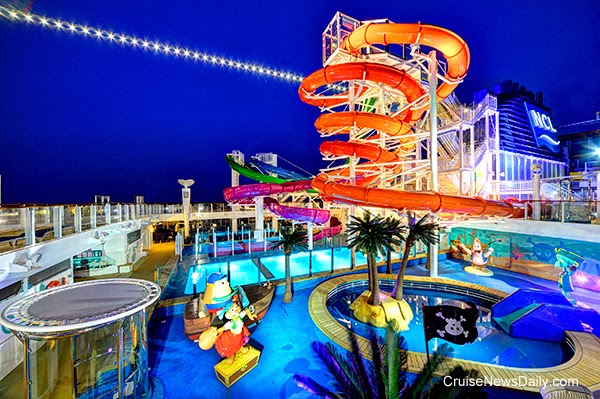
Photos courtesy of Meyer Werft. May not be copied or used without permission. All rights reserved.
More to follow
Photos courtesy of Meyer Werft. May not be copied or used without permission. All rights reserved.
Thursday, January 9, 2014
Cruise News Daily Headlines for January 9, 2014
* Plugging into Los Angeles
In case you might have forgotten, January 1, a new law went into effect at California ports that puts them on the road to all ships docking at all ports in the state having to use shore power, or until they get to that point, seriously reduce their air emissions while in port. January 1, 2014, began the first step, and it was a big one.
The Port of Los Angeles says they were ready, and probably more ready than any other port in the state. Los Angeles has more berths equipped to provide short power than any other of California port.
* Are You Ready for New Year’s Eve?
No, this story isn’t running late. You have to make your reservations early to get into the best places on New Year’s Eve, and Crystal Cruises has already made theirs for next New Year’s Eve - and it is a truly spectacular place they’ve reserved to ring in 2015.
* And the Celebration Continues
Cunard's commemoration of the tenth anniversary of Queen Mary 2 continues to May when there will be two special transatlantic crossings. A special speaker aboard both will be Stephen Payne OBE, who was largely responsible for the overall design of the ship. Cunard has released the interesting video below of Payne speaking about his design and the building of the ship.
The complete articles appeared in the e-mail edition of Cruise News Daily delivered to our subscribers.
Costa Taps AIDA Exec for New VP Position
Paul Soulsby new Senior Vice President Shared Services of Costa Crociere
 Genoa, January 9, 2014 - Costa Crociere is pleased to announce that it has created, as of January 1, 2014, a new position in its top management structure, appointing Paul Soulsby as Senior Vice President Shared Services. In this position he will report directly to Michael Thamm, CEO of Costa Crociere S.p.A.
“I am certain that Paul’s experience and knowledge of our company and our business will allow him to successfully undertake this very important assignment in Costa - commented Costa Crociere S.p.A. CEO Michael Thamm - He will make a substantial contribution to further strengthen our business structure, developing synergies between common practices of the main staff functions."
Paul Soulsby was born in Great Britain in 1960. After qualifying as a Chartered Accountant in 1985 he began his professional career as Audit Manager at KPMG Peat Marwick in Belgium, before serving as European Finance Manager at P&O Containers B.V. from 1992 to 1995. Further appointments included that of West Mediterranean Financial Controller at P&O Nedlloyd Srl as well as Director of Finance and Controlling of Minit Service GmbH in Frankfurt and Düsseldorf.
In September 2001 Paul Soulsby took up the position of Finance Director at AIDA Cruises. In 2004 he was appointed to the Executive Committee of AIDA Cruises as Senior Vice President & CFO. In this capacity Mr. Soulsby led the finance function as AIDA increased its capacity from 1,180 berths to 18,600 berths.
Source: Costa Crociere
Subscribe to:
Posts (Atom)